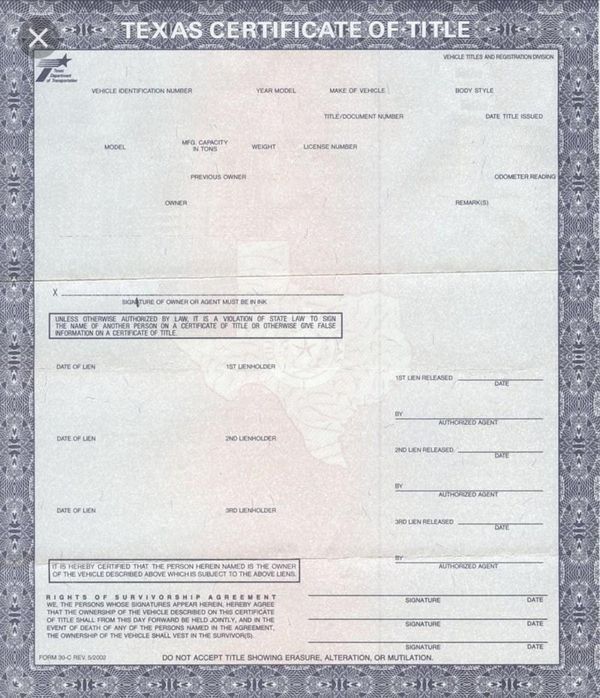
Losing someone is hard enough without a stack of DMV forms waiting at the end of it. But in Texas a vehicle cannot be registered, insured, or sold until the title moves out of the deceased owner’s name, and that transfer happens at the county tax office.
Which path you take depends on three things: whether there was a will, whether the estate has unpaid debts, and how the title itself was held. This guide covers each route, the forms that go with it, and what to do in the case that catches families out most often, which is discovering the original title is nowhere to be found.
The short version
- Every route needs a certified death certificate, Form 130-U, and photo ID.
- No will, no probate? Most families use the Affidavit of Heirship, Form VTR-262.
- A title with survivorship rights or a named beneficiary skips the court entirely.
- Transfers go to the county tax office, not a TxDMV Regional Service Center.
- If the original title is missing, a title bond is the accepted way to prove ownership.
Step 1: Order certified death certificates
Get certified copies from the county clerk or Texas Vital Statistics. A certified copy carries a raised seal or official stamp. Photocopies and home printouts will be refused at the counter.
Order four to six at once. Banks, insurers, and the county tax office each want one, and several will keep it rather than hand it back. Ordering them together is cheaper than going back for singles.
Step 2: Work out which transfer path applies
Three questions decide it. Was there a will? Does the estate owe money? Does the title name a co-owner or a beneficiary?
- Will, and unpaid debts. Full probate, with an executor appointed by the court.
- Will, no unpaid debts. Muniment of Title, a Texas-specific shortcut that skips appointing an executor.
- No will. Affidavit of Heirship, Form VTR-262.
- Co-owner with survivorship, or a named beneficiary. No court involvement at all.
Step 3: Gather the forms
Form 130-U, the Application for Texas Title, is common to every route. What you add to it depends on the path:
| Transfer type | Additional documents |
|---|---|
| Probate with an executor | Letters testamentary or letters of administration |
| Muniment of Title | The muniment court order |
| Affidavit of Heirship | Form VTR-262, notarised, with a disinterested witness |
| Small Estate Affidavit | The court-approved affidavit |
| Right of survivorship | Original title showing survivorship language |
| Transfer on Death beneficiary | Form VTR-121 |
Bring originals. County offices routinely reject photocopies of court orders and death certificates.
Step 4: Go to the county tax office
This is the county tax assessor-collector, not TxDMV. Regional Service Centers handle bonded title applications; they do not process standard transfers.
Call ahead. Requirements vary between counties, and some want extra copies or a particular revision of a form. Bring photo ID and proof of liability insurance in the new owner’s name.
Step 5: Pay the fees and register
The title application fee runs roughly $28 to $33 depending on the county, with registration on top. The county will not process a transfer while a lien is still active, so the loan has to be paid off or formally assumed first.
Heirs have 30 days from the transfer to register the vehicle, and late registration carries penalties. Expect the new title in roughly two to six weeks.
When there is a will
Full probate
The court appoints the executor named in the will and issues letters testamentary confirming their authority. The executor then signs Form 130-U and the title in place of the deceased owner. Nothing can start until those letters exist.
Muniment of Title
If the estate has no unpaid debts beyond a mortgage, Texas lets the court admit the will without appointing an executor. A single court order does the work that letters testamentary would have done. It is faster and significantly cheaper than full probate, and for a family whose main concern is a vehicle it is often the right route.
When there is no will
Texas intestacy law sets the order of inheritance: surviving spouse first, then children, then other relatives. For a vehicle, most families never see the inside of a courtroom, because Form VTR-262 handles it.
The Affidavit of Heirship
VTR-262 is a sworn statement identifying the deceased and every heir. All heirs sign, one signs as seller on behalf of the estate and another as recipient, and the whole thing is notarised.
It also needs a disinterested witness, and this is where filings fail. The witness has to be someone who knew the deceased and the family but who gains nothing from the estate. An heir signing as the witness is the single most common reason a VTR-262 comes back rejected.
The advantage is real: no probate, no waiting period.
Small Estate Affidavit
An option when the whole estate is worth $75,000 or less excluding the homestead. It needs court approval and cannot be filed until at least 30 days after the death. For a vehicle on its own, the Affidavit of Heirship is usually the quicker tool.
When the title skips probate entirely
Right of survivorship
A title marked “with right of survivorship” passes automatically to the surviving co-owner. Bring the original title, the death certificate, and Form 130-U to the county. No court, no delay. A will cannot override survivorship in Texas. Owners set this up at titling time using Form VTR-122.
Transfer on Death beneficiary
A Transfer on Death designation names a beneficiary directly on the title. The beneficiary brings Form VTR-121, the death certificate, and Form 130-U to the county.
There is a hard deadline here: the beneficiary has 180 days from the date of death to apply. Miss it and the designation falls away, and the vehicle goes back through the ordinary estate process.
What every transfer needs
- Certified death certificate, original, not a copy.
- Form 130-U, Application for Texas Title.
- Valid photo ID for the new owner.
- Proof of liability insurance in the new owner’s name meeting Texas minimums.
- Odometer disclosure for vehicles under ten model years old.
- Current registration or the VIN.
When the original title is missing
This is the wall families hit most often. You arrive with the death certificate and the court order, and the title simply is not in the folder. Sometimes it was lost years ago. Sometimes it turns out nobody ever transferred it into the deceased owner’s name in the first place.
A duplicate title is not the answer, because a duplicate requires the owner’s signature and that is no longer possible. The route TxDMV recognises instead is a title bond.
A title bond is a surety bond that stands in for the missing paperwork and proves ownership. The process runs like this:
- Submit Form VTR-130-SOF with the application fee to a TxDMV Regional Service Center.
- TxDMV reviews the evidence and issues a Notice of Determination setting the bond at 1.5 times the appraised value.
- Buy the surety bond from a licensed provider.
- File the bond, the notice, and Form 130-U at the county tax office within 30 days.
- The county issues a bonded title, which converts to a standard title after three years.
We handle this every week for Houston-area families, and the paperwork is the part we can take off your hands. Call (713) 930-6161 and tell us what you have; we will tell you what is missing.
This is general information, not legal advice. Probate rules, county requirements, and state fees change, and estates differ. Confirm the details with your county tax office, TxDMV, or an attorney before you file.