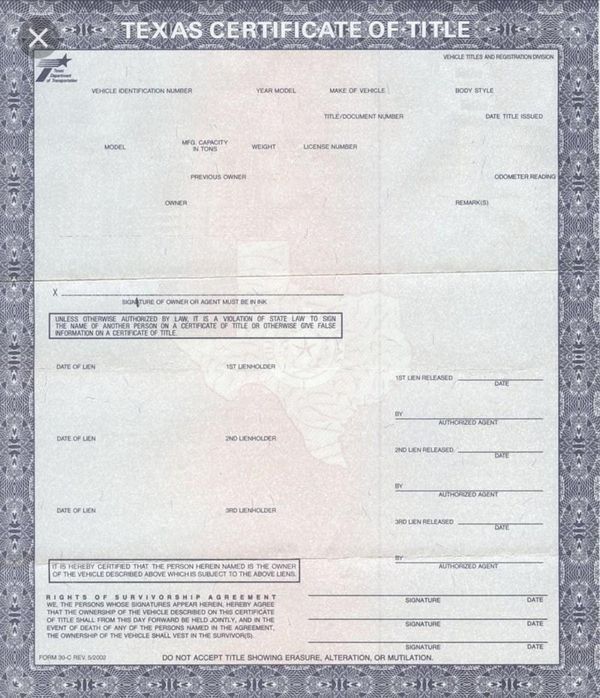

An envelope arrives from the Texas Department of Motor Vehicles, you open it, and the words “Notice of Determination” sit at the top of the page. The language is dry and official and reads like bad news.
It is not. Form VTR-130-ND is an approval. TxDMV has reviewed your application, agreed that it cannot issue you a standard title, and cleared you to get a bonded title instead. The notice tells you exactly how much surety bond you need and how long you have to buy it.
Here is how to read it, the two deadlines that actually matter, and what to do next.
The short version
- The notice is an approval, not a rejection.
- The bond amount printed on it equals 1.5 times your vehicle’s assessed value.
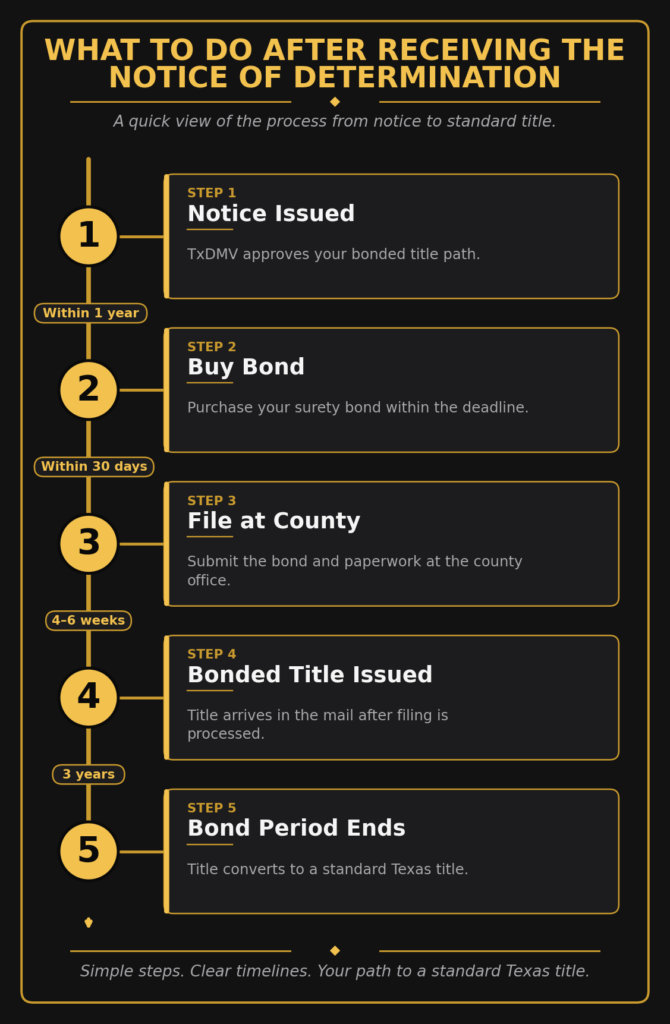
- You have one year from the determination date to buy the surety bond.
- Once you buy the bond, a separate 30-day clock starts to file at your county tax office.
- After three years with no claims, the bonded title becomes a standard Texas title.
What a Notice of Determination actually is
A Notice of Determination is TxDMV’s written answer to a bonded title application. You submitted Form VTR-130-SOF along with whatever evidence of ownership you had. TxDMV checked the vehicle record, confirmed there is no clean way to issue you a normal title, and confirmed nothing disqualifies you from the bonded route.
The notice is the green light. A bonded title is a real Texas title, backed by a surety bond that sits behind it for three years to protect any prior owner or lienholder who turns up with a legitimate claim. You can register, insure, drive, and sell a vehicle on a bonded title.
Why TxDMV sent it to you
Bonded titles exist for vehicles with a broken paper trail. The usual causes:
- You bought the vehicle with nothing but a bill of sale and never got the title.
- The seller signed the title incorrectly, or left the assignment blank, and has since disappeared.
- The vehicle was inherited or gifted with no usable paperwork.
- The original title was lost years ago and was never in your name to begin with.
TxDMV screens for disqualifiers before issuing the notice. A stolen-vehicle flag stops the process outright, and so does an active lien under ten years old with no release on file.
How to read the form
Five fields on VTR-130-ND matter. Check every one against your own records before you spend money, because a mismatch between the notice and the bond you buy means the county sends you home.
| Field | What it means |
|---|---|
| Vehicle description | Year, make, model, and body style tied to the application |
| VIN | The 17-digit number your surety bond has to match exactly |
| Bond amount | 1.5 times the assessed value, set by TxDMV, not negotiable |
| Applicant information | The name and address the bond must be issued in |
| Date of determination | The day your one-year clock starts, not the day the letter arrived |
That last row causes more missed deadlines than anything else on the form. Mail sits in transit, then on a kitchen counter. The clock has been running the whole time.
What to do next, in four steps
1. Check the notice against your records
Compare the VIN character by character with the vehicle itself, not with your memory of it. Confirm the spelling of your name and the address. Write down the bond amount and the determination date somewhere you will see them again.
2. Buy the surety bond
The bond has to match or exceed the amount printed on the notice, and it has to be issued by a licensed surety in the exact name shown on the form. You are not paying the full bond amount, only a premium, which is a fraction of it.
Buy the bond before you go anywhere near the county office. Turning up without it wastes a trip.
3. File at your county tax office within 30 days
Take the surety bond, Form VTR-130-SOF, Form 130-U, and the Notice of Determination to your local county tax assessor-collector office. Budget for the county filing fee. If the vehicle has no existing Texas record, you will also need a VIN inspection on Form VTR-68-A.
Note that this step happens at the county, while the original application went to TxDMV. Different office, different stage.
4. Wait for the title
Expect roughly four to six weeks from filing. The title arrives carrying a bonded brand. Three years later, assuming nobody has filed a claim against the bond, it converts to an ordinary Texas title with full resale rights.
The two deadlines, side by side
Almost everyone confuses these. They run off different start dates.
| Milestone | Deadline | Clock starts |
|---|---|---|
| Buy the surety bond | Within 1 year | Date of determination on the notice |
| File at the county tax office | Within 30 days | The day you buy the bond |
| Bonded title issued | About 4 to 6 weeks after filing | County processing |
| Converts to standard title | 3 years | Date the bond was issued |
Miss the one-year window and the notice expires. There is no extension. You start over with a fresh VTR-130-SOF application and wait for TxDMV to issue a new determination, which means the vehicle sits unregistered for longer.
What gets people rejected at the county counter
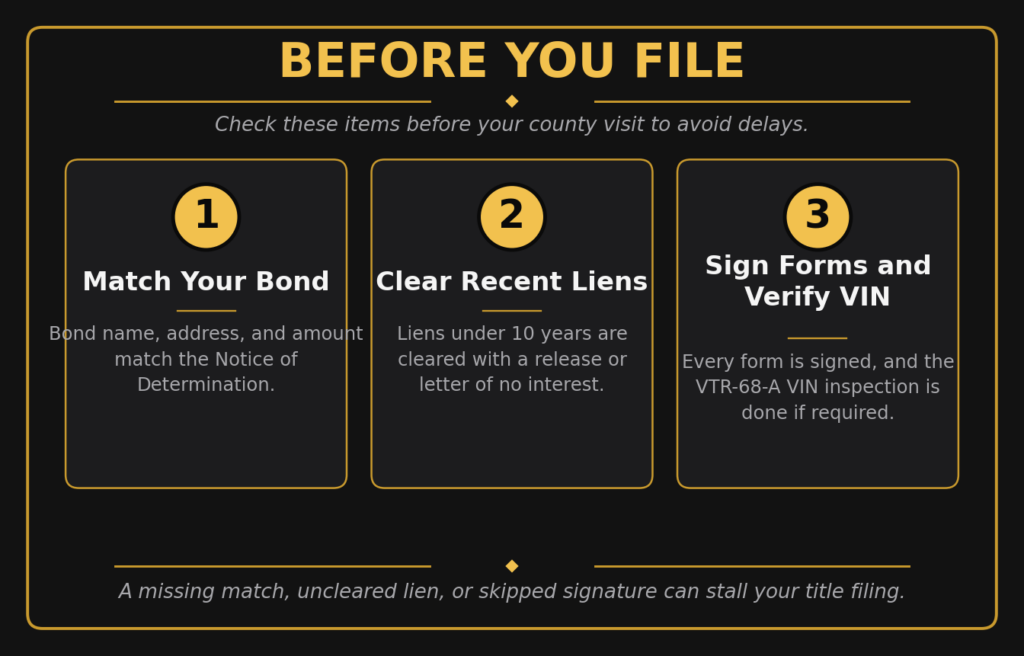
- Bond details that do not match the notice. A different VIN, a different spelling of your name, or a bond written for the wrong amount is an instant rejection.
- An undischarged lien. A lien under ten years old needs a release of lien or a letter of no interest. Check for liens before buying the bond, because the premium is not refundable if the filing dies at this step.
- A missing VIN inspection. If the vehicle has no Texas record, VTR-68-A is not optional.
- Unsigned forms. Sign everything before you leave the house, and bring originals.
Questions we get asked
How long does the whole thing take after the notice?
The bond itself can usually be issued quickly. The bulk of the wait is county processing and TxDMV review after you file, which is where the four to six weeks goes.
Does bad credit stop me getting a title bond?
Generally no. Title bonds at typical vehicle values are written across a wide range of credit profiles. Call us and we will tell you where you stand before you commit to anything.
I got a notice and I never applied. What now?
That means somebody else applied for a bonded title on a vehicle connected to you. If you are the recorded owner or lienholder, you can contest it through TxDMV. The bond exists precisely to protect a claim like yours, and it stays in force for three years.
Can I sell a car on a bonded title?
Yes. It transfers like any other Texas title. You do have to disclose the bonded status to the buyer.
Forms, fees, and deadlines are set by the Texas Department of Motor Vehicles and change from time to time. Confirm current requirements with TxDMV or your county tax office before filing, or call us and we will check for you.